
We're beyond the simple solutions
Fiscal Management
We need to take big action SOON. We can't keep cutting our way to solvency. We're cutting core services, and we'll do it again next year and the year after.
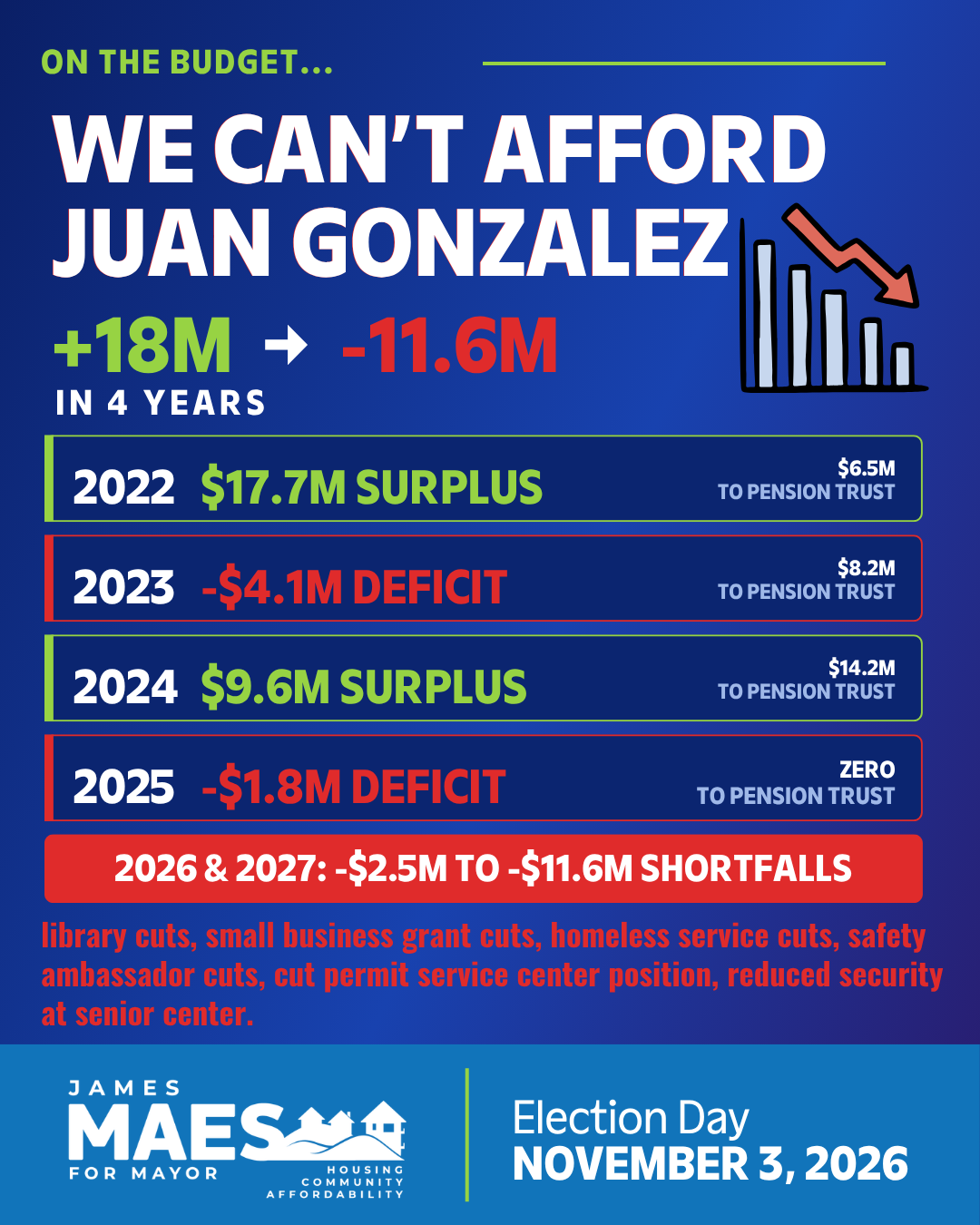
In the four years Juan Gonzalez has been Mayor, our year end balance has gone from a positive $17.7M to a negative $11.6M projected over the next three years. We’re already reducing library hours, crossing guard subsidies, small business grants, homeowner assistance grants. We’re understaffed in the police department and cutting hiring for permit reviews. The very resources we need to process new businesses and new construction are being hobbled.
We talk about having a structural budget problem. That means the very structure holding up our municipal finances is collapsing. In order to maintain proper reserves in our general fund for economic downturns, we’re cutting everything in sight. Even worse…the pension trust fund established by former Mayor Pauline Cutter as a way to address our huge looming unfunded pension liabilities (over $160M) did not get a single dollar contributed from the city in 2025. That’s because we didn’t have the money. And we barely made it out of 2026 by cutting services. Lost opportunities, lost returns on investments.
It’s past time to examine how exactly we will provide the true core services of our city. The services which keep our residents safe, our employees cared for, and our ability to attract and grow new businesses healthy. The talk needs to happen in the open.
When I read the budget presentations done for City Council, they’re littered with meaningless status reports. Things like saving money through “Reimagine program delivery through efficiencies”, or claiming additional library hours are provided by cutting the days in operation by an additional day, and counting the hours from a library yet to be built. If City Hall isn’t honest with themselves, how can they be seen as honest to the public?
It’s time to have the tough discussions and take action.
Sources:
City of San Leandro “Annual Comprehensive Financial Report“, Fiscal Years Ending June 30 2022, 2023, 2024, 2025
City of San Leandro Mid-Cycle FY2027 Update, Work Session Presentation, April 13, 2026
$600K in Investigations, Settlements, Labor Costs
The costs of a toxic work environment.
The amount of city funds paid out to investigators and to settle a lawsuit is equal to the library funding shortfall.
Throughout 2024, 2025, and into 2026, San Leandro has watched as two independent investigations were done in response to complaints of misogyny, harassment, bullying, and gender bias at the highest levels. In addition to the great emotional and physical tolls paid by the complainants, the city lost money, lost time, and lost progress in addressing the needs of its residents.
The Mayor’s silence on these issues is deafening. In fact, he just does not believe that there is a problem. The first step in healing divisions is to acknowledge where we’ve gone wrong, address the issues, and commit to being better, doing better, and leading better.
Below are links to the City Clerk’s page where the full investigation reports are stored. You deserve to know the stories, the outcome, and understand why this issue is so critically important to our city’s healing.
- Link to the main City of San Leandro Public Records Online page (here you can review the reports plus all exhibits and attachments)
- January 5, 2026 report by Jane Kow RE: Bowen complaint (this link goes directly to the report itself; exhibits found through link #1 above)
- November 4, 2024 report by Carl Botterud RE: Robustelli complaint (this link goes directly to the report itself; exhibits found through link #1 above)
- Summary of investigative costs as of November 2025.
On Infrastructure
Slow Progress
When you're given outside funds for a project, MOVE SWIFTLY
I’m a trained and certified Project Management Professional, with experience across many western states, completing projects in water systems, wastewater systems, building schools, homes, apartment complexes. I’ve overseen large environmental rehabilitation projects on behalf of the US Environmental Protection Agency, and the Bureau of Land Management. I’ve gone after polluters, because we should make polluters pay.
Every time I received project funds, we moved quickly to design, advertisement, and groundbreaking. In San Leandro, though, things take a long time. I’m talking years, even decades to get things to the starting line. There is no excuse for watching funds lose value, watch as inflation causes construction costs to increase, and watch as people throw their hands in the air.
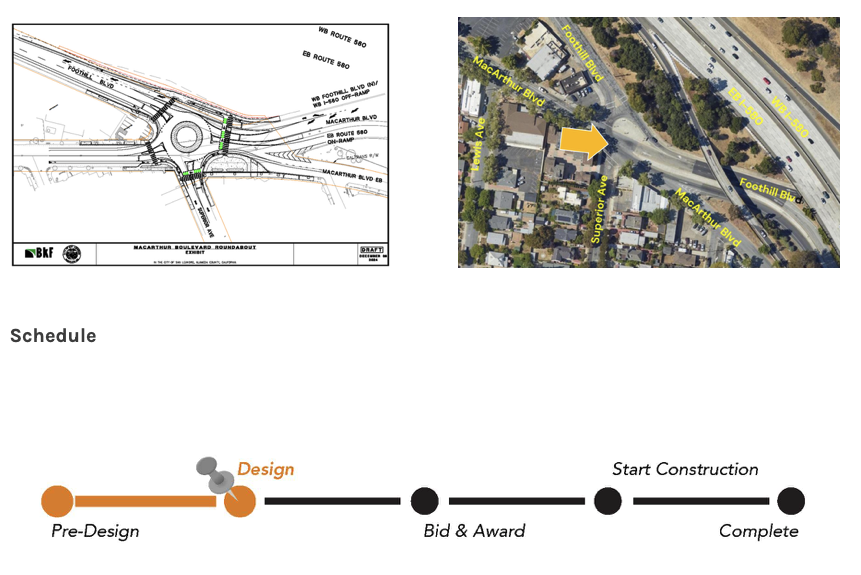
Examples of frustrating projects include the Superior/MacArthur Roundabout. I’ve watched as the same townhomes were driven into by speeding cars flying on MacArthur to get onto the 580 freeway. The project went into “pre-design” in 2015. That was after many years of study. It was designed in 2020 and is supposed to go to bid in February 2027. One intersection. 12 years in the making. Depreciated funds from years gone by. The neighborhood has lost faith that this will happen.
Another example: Lake Chabot Road. Storms wiped out the city-owned section in 2023. It’s been rightfully closed since then, as the roadway is not safe for traffic. Through a combination of DOT, FEMA, State of California, Alameda County, and city funds, we have had the ability to address the serious stability issues in Slide Areas 1 and 4 for a whole year. Still the project sits. Recently, Assembly Member Liz Ortega secured a $1.5 million commitment for additional funds. It’s advertised as a way to reopen the road, but engineering estimates require an amount TEN TIMES what she secured. With our traditional winter rainy season upon us, that road can’t start construction any time soon, so we’re now on year four of the delay. Whether you support reopening the road or not, sitting on money for a project while the cost of diesel literally goes out the roof is bad planning and bad leadership.
As I progressed in my career, I served as Chief of Staff for an organization which built projects large and small across ten western states. I zeroed in on filler language like “continue to wait” or “we continue to work”. My staff learned quickly that a real status update has dates, progress percentages, and that it’s not just OK…it’s REQUIRED to state when things are running late, and when help is needed. I’ll bring accountability to our city government.